
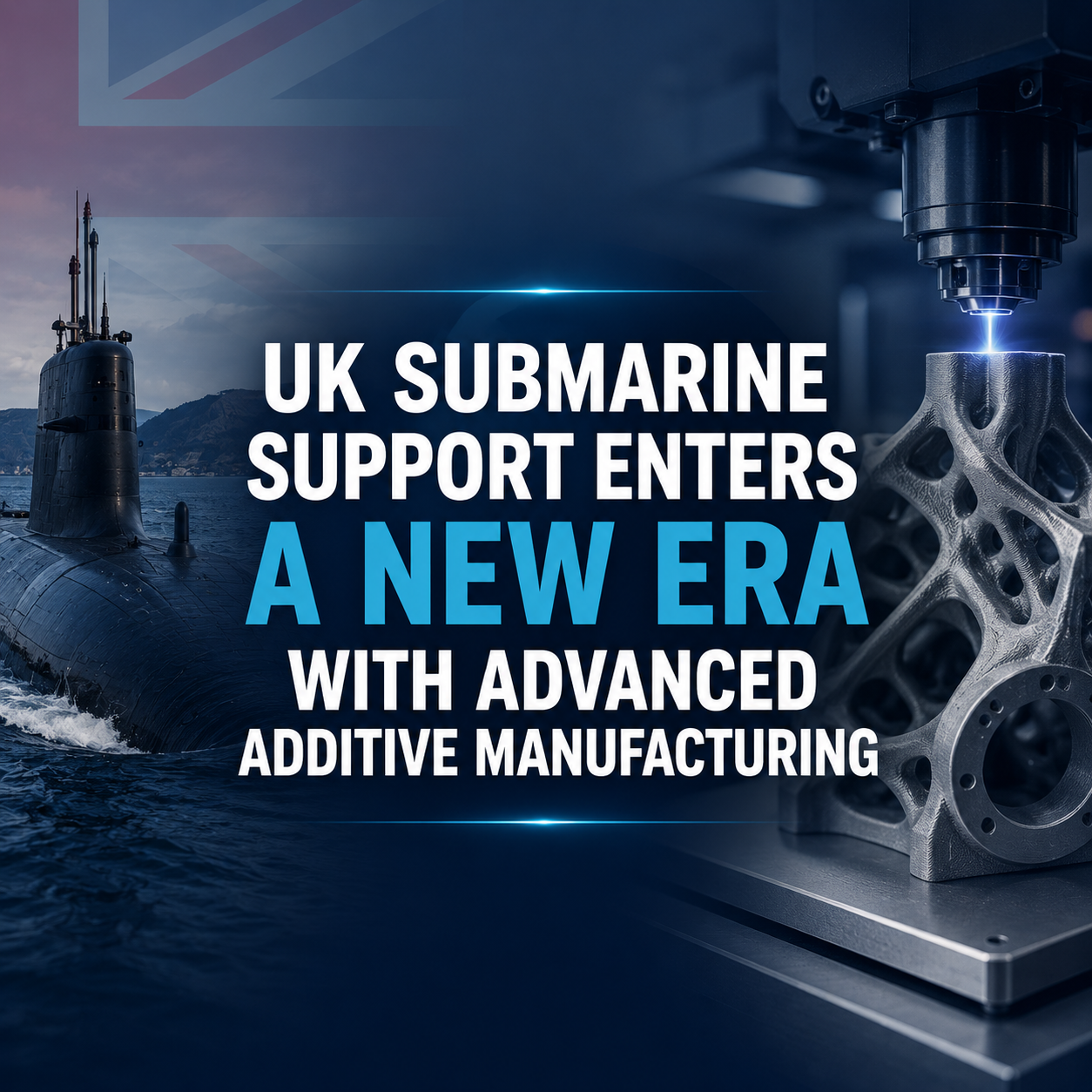
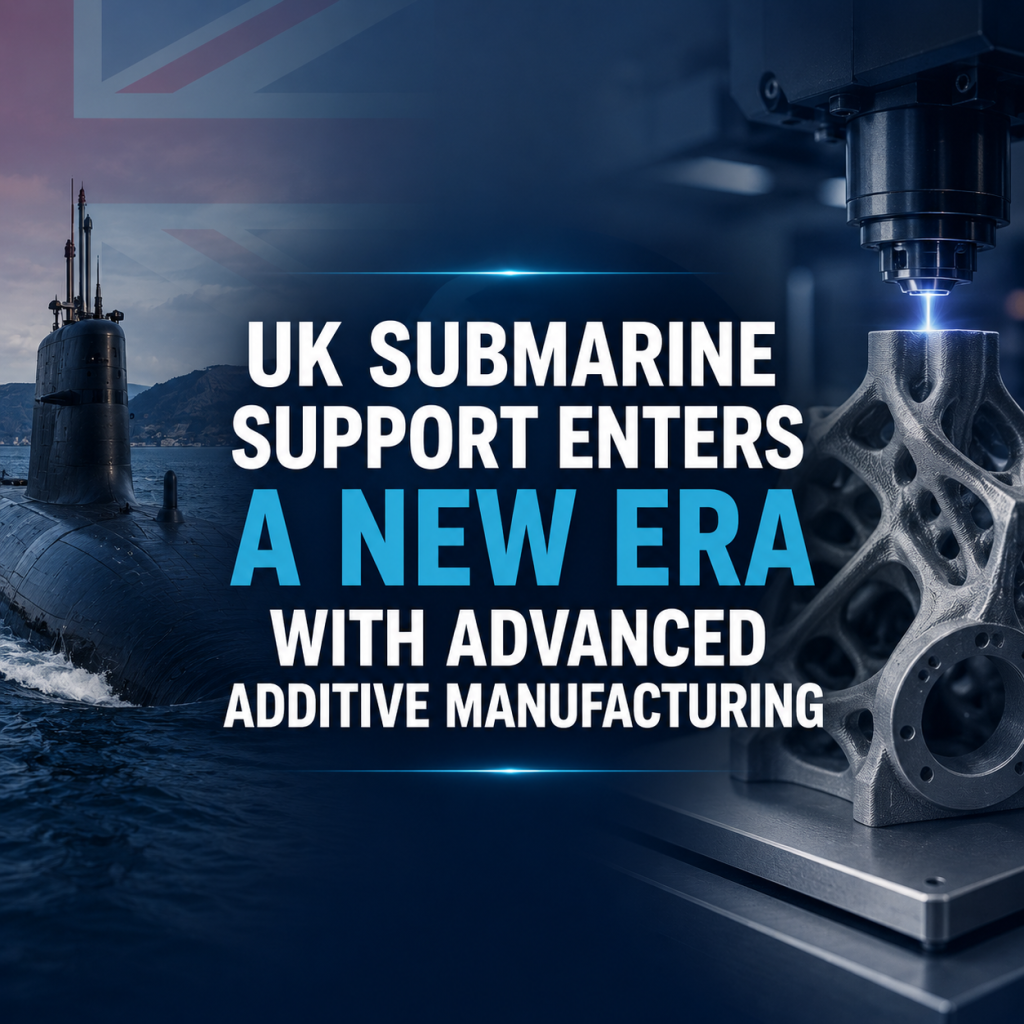
There’s a part sitting somewhere deep inside a nuclear submarine right now. It needs replacing. We we continue to follow the old way getting that part could take months sometimes over a year a slow, rigid, traditional supply chain that wasn’t built for urgency. That’s the quiet crisis the UK’s submarine fleet has been living with. And in 2026, additive manufacturing just showed up with a very practical answer. That is why the UK Submarine Support Enters a New Era with Advanced Additive Manufacturing.
What’s Actually Happening
The UK’s Submarine Delivery Group (SDG), which operates within the Defence Nuclear Enterprise, has been deploying advanced and additive manufacturing to directly improve submarine availability reducing reliance on traditional supply chains while building a lasting Additive manufacturing industrial capability across the country’s submarine programme.
The headline move is the deployment of on-site manufacturing capability at HM Naval Base Clyde better known as Faslane, the home of the UK’s nuclear submarine fleet. Through two contracts with the SDG’s Additive Manufacturing team, QinetiQ is now running a facility that allows submarine components to be manufactured to order and delivered dockside at pace including the Additive Manufacturing All In One solution, described as a UK sovereign point-of-need capability.
But Here’s the Real Story: It Already Worked in the Field
Before we even get to Faslane, there’s a proof-of-concept story that deserves more attention.
Earlier this year, QinetiQ supported HMS Anson’s routine submarine maintenance period in Australia by using additive manufacturing to deliver replacement parts in just four weeks a turnaround the company described as significantly faster than the months or even years typically required through conventional supply chain routes.
Think about that. A nuclear submarine docked in Perth, Western Australia far from home needed critical components. And instead of waiting for parts to be shipped from the UK or manufactured through a slow procurement cycle, components were produced locally by additive manufacturing SMEs in Perth, with the remainder made on Australia’s east coast and by QinetiQ Australia.
Four weeks. Not six months. Not a year. Four weeks.
That experience directly informed the design and operational concept of the All In One facility now being installed at Faslane. This isn’t theory catching up to practice it’s practice writing the theory. Additive manufacturing is going on in almost every developed country just as Austal back new additive manufacturing growth.
How this id going to work
This is not just about fixing submarines faster. There’s a bigger game being played here.
The deployable workshops and the broader additive manufacturing programme directly support the Submarine Maintenance Recovery Plan (SMRP), launched by the First Sea Lord in January 2026 designed to bring manufacturing capability to the front line and support a more agile, responsive maintenance model in UK.
The First Sea Lord himself put it bluntly: the technology has the potential to change how submarines are maintained cutting time alongside and increasing fleet availability. For a navy that has faced real pressure on submarine readiness in recent years, that’s not a throwaway line.
And then there’s AUKUS. Additive manufacturing is a key enabler of the AUKUS submarine partnership, with the SDG working alongside US and Australian submarine industrial bases to align standards, share manufacturing pathways, and build a distributed but connected maintenance capability across three allied nations.
Once additive manufacturing becomes embedded in allied industrial cooperation, it stops being just a local maintenance tool it becomes part of a wider sustainment architecture where trusted partners can share standards, data, and manufacturing pathways for common fleets.
What Additive Manufacturing Industry Should Take From This
For anyone working in additive manufacturing, this story carries a few lessons worth sitting with.
First, speed is the killer feature in defence applications. Procurement timelines dropping from months to weeks is not a marginal improvement it’s the kind of result that changes how decision-makers think about AM’s role in critical operations.
Second, distributed manufacturing works. The HMS Anson case didn’t rely on one centralised facility shipping parts across the world. It activated local SMEs, regional capacity, and allied industrial networks. That distributed model is replicable and it’s exactly what makes AM dangerous to old-school supply chain thinking.
Third, in early 2025, the US Navy’s NAVSEA had already approved 182 additively manufactured parts for use in ships and submarines, with more than 600 additional components under engineering review which tells you the regulatory confidence in AM for submarine applications is building fast, not slowly.
The Bottom Line
The submarine maintenance story is not just a defence headline. It’s a live demonstration of what additive manufacturing looks like when it moves from pilot project to operational backbone.
Parts on demand. Four-week turnarounds where years were normal. Manufacturing capability deployed dockside. Allied nations sharing a common industrial framework.
The technology has been proving itself for years. What 2026 is showing us is what happens when institutions actually commit to deploying it at scale and what’s possible when they do.
Join our additive manufacturing news community for expert discussion and insights.
Join 900+ Members
✅ Learn from Industry Experts
✅ Connect with a Global Network
Leave a Reply