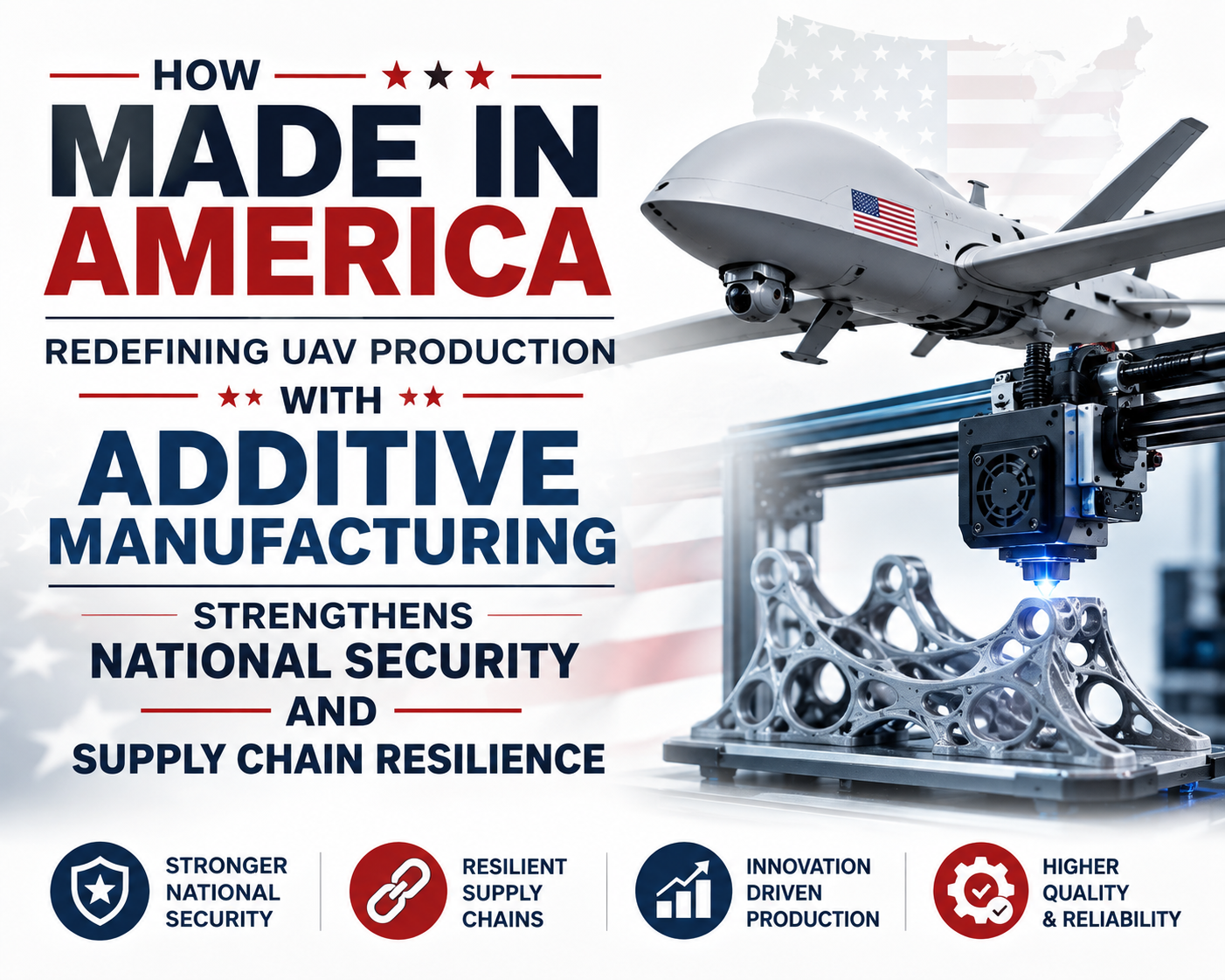
How Made in America Redefining Uav Production with Additive Manufacturing
Military and commercial drone markets face a critical turning point. Geopolitical tensions and fragile supply chains expose the risks of relying on foreign manufacturing. Consequently, domestic aerospace pioneers are looking toward localized, advanced manufacturing. The strategic initiative of Made in America Redefining Uav Production with Additive Manufacturing offers a powerful path forward. By leveraging industrial 3D printing, domestic manufacturers can bypass traditional supply chain bottlenecks. Therefore, this paradigm shift is not just about local assembly; it is about rewriting the rules of aerospace production.
Key Takeaways
- Sovereign Supply Chains: Localized 3D printing mitigates geopolitical risks and eliminates reliance on foreign component suppliers.
- Unparalleled Design Flexibility: Additive manufacturing enables lightweight, optimized structural designs that traditional methods cannot replicate.
- Rapid Deployment: Tool-less manufacturing accelerates prototyping cycles from weeks to hours, ensuring faster field deployment.
- Cost Efficiency: Eliminating physical molds reduces warehousing costs and makes low-volume production highly profitable.
The Vulnerability of Global Drone Supply Chains
For decades, global drone production relied heavily on overseas suppliers. This approach created significant vulnerabilities, particularly regarding component origin and software integrity. Consequently, Western defense agencies have raised alarms over potential espionage and hardware backdoors.
Furthermore, transport delays and trade wars can halt assembly lines instantly. As a result, reliance on traditional tooling and long-distance shipping is no longer viable. Therefore, domestic defense contractors must pivot toward secure, localized manufacturing processes.
By rebuilding the industrial base, the United States can secure its technological edge. In addition, localizing the supply chain ensures that sensitive intellectual property remains protected. This transition is essential for national security.
Why Made in America Redefining Uav Production with Additive Manufacturing Matters Today
Securing national defense requires immediate, agile manufacturing solutions. Therefore, the concept of Made in America Redefining Uav Production with Additive Manufacturing has become a strategic priority. This methodology allows engineers to print complex drone chassis and internal components on demand.
Consequently, manufacturers can completely bypass foreign component suppliers. In addition, this shift aligns directly with federal mandates like the National Defense Authorization Act (NDAA). As a result, government agencies are actively funding projects that utilize Made in America Redefining Uav Production with Additive Manufacturing.
Furthermore, localized production reduces carbon footprints by eliminating international shipping. Consequently, this sustainable approach appeals to both public and private sectors. By focusing on Made in America Redefining Uav Production with Additive Manufacturing, aerospace firms guarantee supply chain resilience.
Therefore, this technological revolution ensures that American defense systems remain robust and self-reliant. Indeed, the integration of advanced materials and 3D printing is paving the way for a new era.
Technical Breakthroughs: How 3D Printing Empowers UAV Design
Traditional manufacturing methods often limit drone design complexity. However, additive manufacturing removes these geometric constraints entirely. Consequently, engineers can create highly optimized, organic shapes that were previously impossible to produce.
Lightweighting and Structural Optimization
Weight is the ultimate enemy of flight efficiency. Fortunately, additive manufacturing allows for internal lattice structures that reduce weight while maintaining high strength. As a result, drones can fly longer, carry heavier payloads, and consume less energy.
Furthermore, consolidating multiple parts into a single printed component reduces assembly time. Consequently, this integration minimizes the risk of structural failure at connection points. Therefore, structural optimization directly enhances drone reliability.
Rapid Prototyping and Iterative Design
In the fast-paced defense sector, speed to market is critical. Traditional injection molding requires weeks to design and produce custom tooling. However, 3D printing enables rapid prototyping in a matter of hours.
Consequently, design teams can test, modify, and reprint prototypes within a single day. This rapid iteration cycle accelerates the deployment of cutting-edge aerial technology. Therefore, the timeline from initial concept to battlefield deployment is drastically reduced.
Economic and Logistical Advantages of Onshoring
Onshoring drone production might initially seem expensive. However, additive manufacturing offsets these costs by eliminating expensive tooling and molds. Consequently, low-volume production runs become highly cost-effective.
Eliminating Warehousing and Tooling Costs
Storing physical molds and spare parts requires vast warehouse space. In contrast, 3D printing relies on digital inventory files. Therefore, spare parts can be printed on demand, eliminating storage fees entirely.
Furthermore, the absence of physical tooling allows for immediate design updates. If a component needs modification, engineers simply update the CAD file. Consequently, there are no expensive retooling costs or production delays.
Just-In-Time Manufacturing for Defense and Enterprise
Just-in-time manufacturing ensures that parts are produced only when needed. As a result, companies do not tie up capital in excess inventory. This flexibility is highly beneficial for defense applications where mission requirements change rapidly.
Furthermore, localized production hubs can be established close to military bases. Consequently, replacement parts can be fabricated directly in the field. Therefore, operational readiness is maintained at all times.
Material Innovations Driving Next-Gen Drones
The success of Made in America Redefining Uav Production with Additive Manufacturing relies heavily on advanced materials. Today, aerospace-grade polymers and metal alloys are replacing traditional plastics. Consequently, printed drones can withstand extreme environmental conditions.
For instance, high-performance thermoplastics like ULTEM and PEEK offer exceptional strength-to-weight ratios. Furthermore, these materials resist high temperatures and chemical exposure. Therefore, they are ideal for military-grade aerial vehicles.
In addition, carbon-fiber reinforced composites provide unmatched rigidity. Consequently, drones built with these materials can endure high-speed maneuvers without structural deformation. As a result, material science continues to expand the boundaries of UAV capabilities.
Therefore, implementing Made in America Redefining Uav Production with Additive Manufacturing ensures that drones are built with the most advanced materials available. Indeed, this focus on Made in America Redefining Uav Production with Additive Manufacturing allows for unprecedented customization.
Enhancing National Security Through Sovereign Manufacturing
Sovereign manufacturing capability is a cornerstone of national defense. Consequently, relying on foreign nations for critical drone components poses a severe risk. By embracing Made in America Redefining Uav Production with Additive Manufacturing, the nation secures its supply chain.
Furthermore, military operations require secure communication protocols. If drone hardware is manufactured overseas, the risk of cyber tampering increases. Therefore, domestic production ensures that every microchip and structural component is fully vetted.
As a result, defense agencies can trust the integrity of their aerial fleets. Consequently, the economic benefits of Made in America Redefining Uav Production with Additive Manufacturing extend far beyond defense. Therefore, investing in domestic additive manufacturing is a strategic necessity for national sovereignty.
Scalability and the Future of Autonomous Swarms
The future of aerial warfare and commercial logistics lies in drone swarms. However, producing hundreds of coordinated drones requires unprecedented manufacturing scalability. Fortunately, additive manufacturing facilities can scale production rapidly by adding more 3D printers.
Consequently, a single facility can produce diverse drone configurations simultaneously. Therefore, the concept of Made in America Redefining Uav Production with Additive Manufacturing is vital for future military tactics. This flexibility is crucial for deploying autonomous swarms with specialized roles.
Furthermore, software integration allows these printed drones to coordinate autonomously. As a result, defense forces can deploy cost-effective, sacrificial swarms to overwhelm adversaries. Consequently, this technology completely redefines modern tactical strategies.
Therefore, the marriage of AI and additive manufacturing will dictate the future of aerospace. By prioritizing Made in America Redefining Uav Production with Additive Manufacturing, domestic firms lead this transformation.
Overcoming Challenges in Additive UAV Manufacturing
Despite the obvious benefits, some challenges remain in additive manufacturing. For instance, achieving consistent surface finish and dimensional accuracy requires precise calibration. Consequently, quality control standards must be strictly enforced.
Furthermore, certifying 3D-printed parts for aerospace use is a rigorous process. However, industry collaborations are rapidly establishing standardized testing protocols. Therefore, these regulatory hurdles are quickly being overcome.
In addition, the initial cost of industrial 3D printers can be high. Nevertheless, the long-term savings in material waste and tooling make it a wise investment. Consequently, more companies are adopting Made in America Redefining Uav Production with Additive Manufacturing every year.
Thus, the ongoing success of Made in America Redefining Uav Production with Additive Manufacturing depends on continuous workforce development. Therefore, the transition to additive manufacturing is accelerating across the entire aerospace sector.
Industrial Applications of Additively Manufactured Drones
Beyond defense, many commercial industries benefit from localized drone production. For example, the agricultural sector uses drones for precision crop monitoring. Consequently, farmers require durable, customized aerial platforms.
Furthermore, search and rescue teams rely on drones to navigate hazardous environments. In these critical situations, custom sensor payloads must be integrated quickly. Therefore, Made in America Redefining Uav Production with Additive Manufacturing provides the necessary customization.
In addition, utility companies use drones for inspecting power lines and pipelines. These drones must operate reliably in harsh weather conditions. As a result, the high-quality materials used in additive manufacturing are essential.
Consequently, the demand for domestic, high-performance drones continues to rise. By focusing on Made in America Redefining Uav Production with Additive Manufacturing, commercial enterprises secure reliable equipment. Therefore, this industrial shift supports the entire domestic economy.
The Role of Government Policy and Funding
Government initiatives play a pivotal role in accelerating domestic manufacturing. For instance, federal grants and tax incentives encourage aerospace firms to adopt 3D printing. Consequently, these policies drive private sector innovation.
Furthermore, the Department of Defense actively partners with academic institutions. This collaboration fosters research into advanced additive manufacturing techniques. Therefore, the pipeline of skilled engineers and cutting-edge technology remains strong.
By aligning public policy with industrial capacity, the nation accelerates its manufacturing goals. Consequently, Made in America Redefining Uav Production with Additive Manufacturing is a unified national effort. Therefore, continued government support is vital for maintaining this technological momentum.
Setting a New Standard for Aerospace Innovation
The integration of 3D printing in drone production represents a massive leap forward. Consequently, domestic manufacturers are setting new global benchmarks for quality and efficiency. By embracing Made in America Redefining Uav Production with Additive Manufacturing, companies prove that localized production is highly competitive.
Furthermore, this approach fosters a culture of continuous improvement. Since designs can be updated instantly, products never become stagnant. Therefore, customers always receive the most advanced technology available.
As a result, the global market is taking notice of these superior domestic products. Consequently, Made in America Redefining Uav Production with Additive Manufacturing is transforming the broader industrial landscape. Therefore, this movement is not just a temporary trend; it is the future of manufacturing.
Frequently Asked Questions
How does additive manufacturing improve drone flight performance?
Additive manufacturing allows engineers to design complex, lightweight internal structures like lattices. Consequently, this significantly reduces the overall weight of the UAV. As a result, drones experience longer flight times, improved battery efficiency, and the ability to carry heavier payloads.
Why is domestic UAV production critical for national security?
Relying on foreign suppliers introduces severe risks of supply chain disruption and hardware tampering. Indeed, the movement of Made in America Redefining Uav Production with Additive Manufacturing directly addresses these vulnerabilities by ensuring every component is manufactured securely within domestic borders, eliminating the threat of foreign espionage.
What materials are commonly used in 3D-printed military drones?
Aerospace manufacturers utilize high-performance thermoplastics like ULTEM, carbon-fiber reinforced composites, and lightweight metal alloys. These advanced materials offer incredible strength, heat resistance, and structural rigidity. Therefore, they are perfectly suited to withstand the demanding conditions of military missions.
Can additive manufacturing scale to meet high-volume drone demands?
Yes, additive manufacturing facilities can scale production rapidly by deploying larger print farms. Furthermore, this method eliminates the time-consuming process of creating molds and tooling. Consequently, Made in America Redefining Uav Production with Additive Manufacturing ensures that critical parts can be produced on-demand and scaled rapidly to meet urgent defense needs.
Revolutionize Your Aerospace Production
Discover how advanced additive manufacturing can secure your supply chain, reduce development costs, and bring high-performance UAVs to market faster.
About the Author